


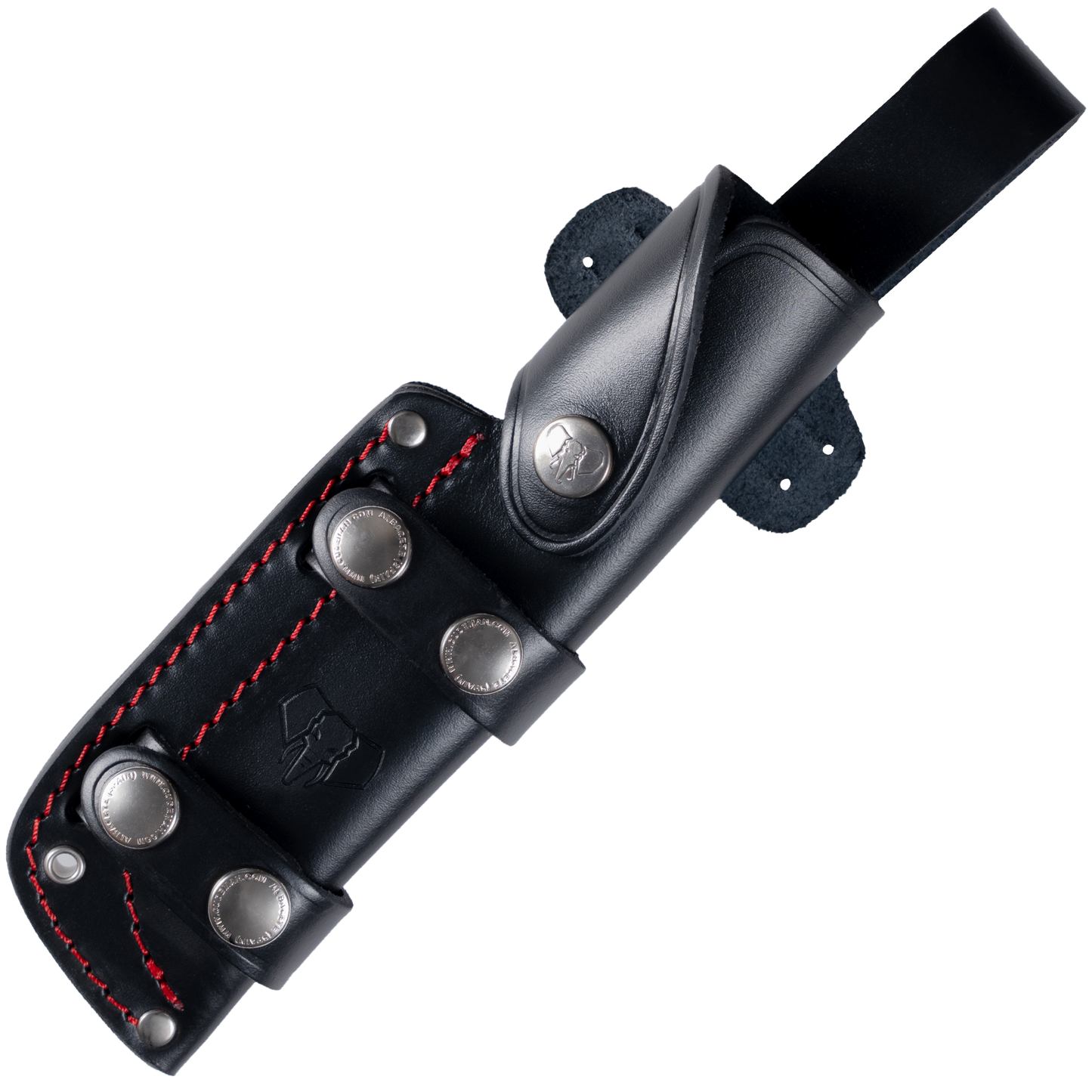
Cudeman JJSK1 (124-M): the survival knife that set a new standard
Some tools follow trends and others create them. The Cudeman JJSK1, reference 124-M, belongs firmly to the second group. It was born in 2013 from a collaboration with Juan Jose Sanchez, founder of the "JJ Adventure" school, with the goal of breaking away from the usual conventions of outdoor cutlery. This piece was well ahead of its time within Cudeman's production in Albacete, bringing together solutions drawn from real fieldwork, such as the friction-fire bow drill socket and a complete survival kit housed in the sheath itself. It is a knife designed by instructors and for instructors, for whom a mistake in the middle of an emergency is simply not an option.
What sets this model apart
- Fire-making independence: it was a pioneer in adding a socket in the handle for bow-drill friction fire, along with a notch on the blade designed to throw sparks from a ferro rod with real ease.
- Power for impact and rescue: the solid glass breaker on the pommel becomes a rugged striking tool for extreme situations or for working through especially hard materials.
- Precision for fine cutting: the jimping on the spine locks the thumb in place and lets you carve tinder or set up traps without the hand slipping.
- Outstanding cutting bite: the hollow grind of the blade bites into wood with a cleanliness and force rarely seen in knives of this thickness.
Steel and edge
The JJSK1 features Bohler N-695 steel hardened to 59/60 HRc. This high-end alloy delivers professional-grade edge retention and withstands the abrasion of prolonged work in the field without losing its cutting power. It also offers notable corrosion resistance, so it performs flawlessly in the rain or in extremely humid environments. Despite its hardness, it responds very well to honing with diamond or ceramic stones, keeping the tool always ready for action.
Construction and durability
The build is full tang, with a 5 mm thickness. The steel runs through the entire piece from the tip to the rear glass breaker, creating a compact unit that does not give way under normal survival use. The stainless Allen screws, with threaded brass bushings, ensure a precise mechanical fit. It is worth keeping one logical limitation in mind: since this is a hollow-ground blade, optimised for very fine cutting, it is wise to avoid abrupt lateral prying on overly hard wood or knots, so as to preserve the delicate edge geometry.
Handle and ergonomics
The handle is made of satin-finished black Micarta, finished with a red spacer that helps dampen the vibrations of a strike. Micarta is a high-density synthetic composite that is unaffected by mud, resin or water, ensuring a stable grip in any weather. Its anatomical profile fits the hand and locks the fingers in naturally, while the lanyard hole adds an extra margin of safety when working near drop-offs or watercourses.
Sheath and carry options
The black leather sheath design with red stitching left its mark and served as the starting point for other flagship pieces from the brand, such as the Entresierras or the ENT model. There are three configurations to adapt the carry to each situation:
- 124-M: multi-position black leather sheath (vertical and horizontal), with loops and rivets that provide maximum versatility.
- 124-MC: full leather version that adds the survival kit (sharpening stone, signal mirror, ferro rod and 2.8 metres of paracord).
- 124-M-K: black Kydex sheath geared towards firm mechanical retention and tactical or water-oriented carry.
Use cases
- Complete survival: its all-round approach makes it easy to start fires, build shelters and process wood safely.
- Demanding bushcraft: the thick spine together with the hollow grind cover everything from controlled impact to detailed carving of wooden utensils.
- Rescue and emergencies: between the glass breaker and the solidity of its materials, it is a highly reliable first-response tool.
Care and maintenance
- Cleaning the steel: it is best to wash and thoroughly dry the blade after every outing, especially after striking a ferro rod, cutting wet branches or handling food.
- Caring for the handle: being synthetic Micarta, the scales need no oiling; a simple brushing with soap and water is enough to remove caked-on dirt.
- Checking the hardware: occasionally checking the tightness of the Allen screws keeps the frame as a solid block after the toughest tasks.
- Resharpening: when restoring the edge of the Bohler N-695, always respect the original hollow angle so as not to alter its cutting geometry.
The Cudeman JJSK1 (124-M) is that companion that never fails when the situation gets tough. Available at Navajeria with shipping across mainland Spain.


