


Cudeman JJSK 2 (125-M): the long-bladed survival knife for the most demanding terrain
The Cudeman JJSK 2, reference 125-M, is the largest model in the celebrated survival series from the Albacete maker. Released a year after its predecessor, this knife came about in response to those asking for a longer, more substantial blade to tackle hostile environments. Its 15 cm cutting edge makes it a tool designed both for cutting a path through the wild and for gaining a tactical edge when you have nothing but your own kit to rely on.
There is an interesting story behind its handle: the demand for a more generous grip for large hands led Cudeman to redesign and widen this handle. The result was so successful that the maker ended up carrying those extra centimetres over to the original JJSK 1 as well. To grip the JJSK 2 is, therefore, to feel the maturing of a design conceived never to falter.
What sets this model apart
- Greater cutting capacity: the 15 cm blade together with the clip-point tip lets you take on heavier work, from light chopping to deep cuts, with less effort.
- Refined ergonomics: the widened handle suits large hands or use with thick gloves, reducing fatigue and improving control over the blade's momentum.
- Fire-starting independence: it keeps the integrated striker for friction fire and the dedicated notch on the blade for scraping a ferro rod efficiently.
- Useful in emergencies: the solid rear glass-breaker adds an impact and rescue function for extreme situations.
Steel and edge
The heart of this high-performance tool is Bohler N-695 steel, hardened to 59/60 HRc. This professional-grade alloy offers notable edge retention on long treks, withstands the wear of continuous work on wood and resists corrosion very well. Its edge is tough, yet it touches up easily in the middle of camp with diamond or ceramic stones, so its aggressive bite is always ready for the next task.
Construction and toughness
The strength of the JJSK 2 rests on a full-tang construction with a 5 mm thickness: a single solid steel plate that takes the rough handling of survival use without flinching. Assembly uses stainless Allen hardware, with brass inner bushings. The hollow grind gives it an almost surgical cutting edge, which is why the blade should not be used to pry forcefully against stone or knot-heavy wood, so as to keep its geometry intact.
Handle and field control
The scales are made of satin-finish black Micarta and are completed with red spacers that cushion the shock of impacts. Micarta provides a firm grip that holds up in any weather: it does not slip in the rain, nor does it absorb blood, mud or resin. The revised anatomical contour, combined with the lanyard hole, locks the hand in position and delivers a secure grip even under intense muscle fatigue. Like its smaller sibling, the Cudeman JJSK1, this model also features the striker for friction fire-starting.
Sheath and carry options
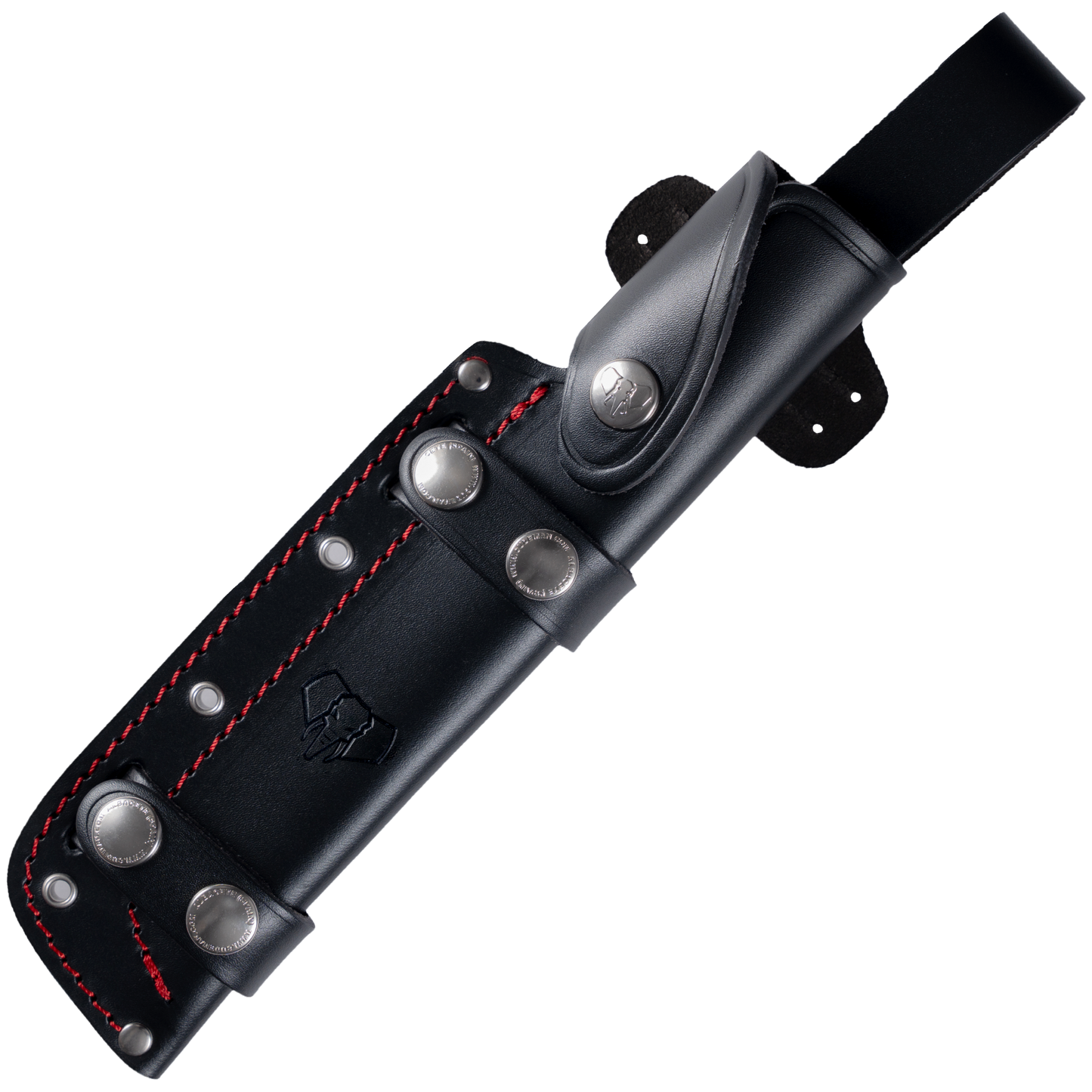
Carrying a knife of this size calls for security and versatility. The JJSK 2 comes with its distinctive multi-position sheath with red stitching and is offered in three different configurations depending on the type of outing:
- 125-M: the basic version in black leather, fitted with loops and rivets that allow both vertical and horizontal carry, stable and silent.
- 125-MC: the complete survival kit in black leather, which includes all the extra gear: leather adapter, sharpening stone, signalling mirror, ferro rod and 2.8 metres of paracord.
- 125-M-K: a tactical alternative made in Kydex, perfect for wet environments or operations where a constant mechanical hold alongside a fast draw is required.
What it is for
- Survival: its size and sturdy spine help build large shelters and process medium logs effectively.
- Long-range bushcraft: it handles heavy stock removal and precision cuts by resting the thumb on the non-slip jimping along the spine.
- Intervention and rescue: its large size, together with the solid glass-breaker, qualify it as a primary tool for forcing openings and freeing someone who is trapped.
Care and maintenance
- Cleaning the steel: after scraping the ferro rod with the notch, it is best to dry and clean the blade thoroughly to remove charred residue and prevent staining on its face.
- Caring for the Micarta: being a high-density synthetic material, the handle needs no hydration; water and a brush are enough to clear away ingrained dirt.
- Checking the frame: periodically check the tension of the Allen screws so the scales keep their firmness after repeated impacts.
- Preserving the grind: when resharpening, respect the original angle of the Bohler N-695 hollow grind so as not to reduce its fine cutting ability.
The Cudeman JJSK 2 (125-M) proves that listening to the customer makes the tool better. Available at Navajeria, it is a survival heavyweight built never to give up.


